









What is 3D Printing and Additive Manufacturing?
3D Printing and Additive Manufacturing is a process used to create three-dimensional objects from digital CAD files by joining materials layer by layer. At Wellstronics3D, we utilize this technology to provide professional prototyping and industrial production services across the Minneapolis-St. Paul metro.
We specialize in high-performance materials and advanced technologies—including FDM, SLA, and SLS—to deliver functional, end-use parts. Whether you need a single custom component or low-volume production runs, we provide the scalability and precision your project demands.

Precision resin 3D printing service in Minneapolis & St. Paul
Engineering grade & functional materials
Form & Fit Functional Validation
On-Demand Low Volume Manufacturing
High-Resolution & Smooth Surface Finishing
SLA Prototyping for Manufacturing with Injection Mold Quality

Production-grade FDM / FFF 3D printing service in Minneapolis & St. Paul
High-Performance Composites (Carbon Fiber & Nylon)
Industrial Low Volume Production
On-Demand Capacity & Same-Day Turnaround
Repeatable Dimensional Accuracy
Engineering Grade Plastics (ABS, PC, PA, ULTEM & More)

Industrial SLS 3D printing service in Minneapolis & St. Paul
Production Grade - Nylon PA12 / Nylon PA11 / TPU
On-Demand Low Volume Production Runs
Rapid Turnaround SLS Service | Local Minneapolis Pickup
Support-Free Complex Geometries & End-Use Parts
Durable Prototypes & Isotropic Parts

Expert product development and 3D prototyping services in the Twin Cities
Fast turnaround (24-48 hour shipping options)
Form, Fit and Functional Testing
Engineering Grade Plastics & Performance Polymers
Design for Manufacturing (DFM) feedback
Rapid Prototype Assembly & Bridge Production

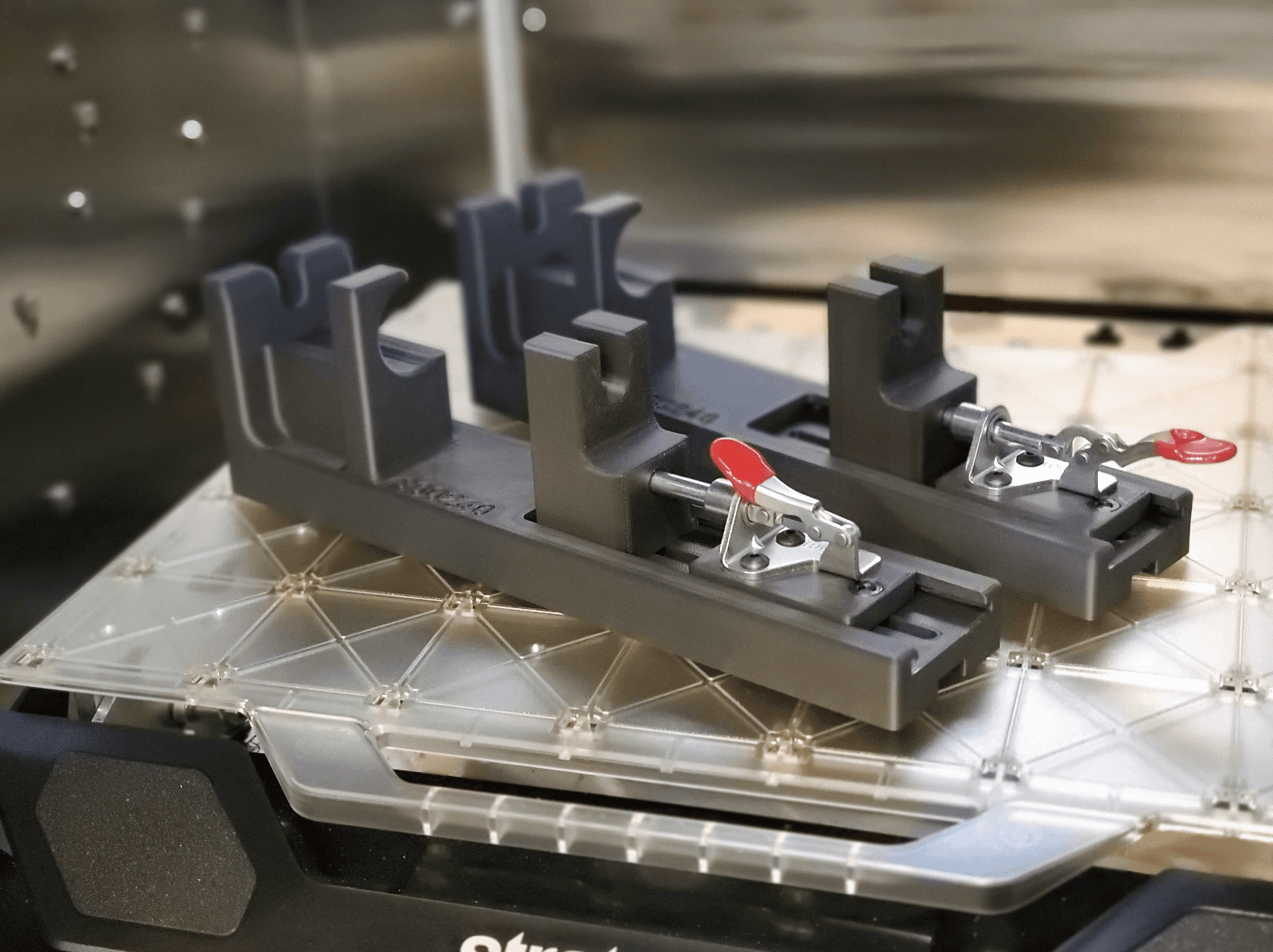
Cost-effective 3D printing for functional jigs, fixtures, and shop aids.
Workhorse materials including industrial-grade PLA and PETG.
Ideal for manufacturing aids, jigs, and fixtures on the shop floor.
Affordable 3D printing for high-volume, early-stage prototyping.
Fast-turnaround large batch production with our industrial fleet.
Precise, rigid parts with a low $65 minimum setup fee.

Fast-turnaround small batch manufacturing and industrial tooling.
Short-run production of hundreds to thousands of end-use parts
3D printed bridge tooling to skip expensive injection mold costs
Custom end-of-arm tooling (EOAT) and robotic grippers
Strategic supply chain solutions with on-demand digital inventory
Consistent quality for small batch manufacturing projects
Which 3D printing process is best for functional testing?
The choice depends on your specific application: FDM is ideal for large parts and rugged, high-strength jigs and fixtures; SLA provides high-resolution, smooth surface finishes that are similar to injection mold quality; and SLS is best for low volume manufacturing end-use parts. If your not sure which material to use, let us know what your goal is and we will suggest a matrial.
How accurate are your 3D printed parts for mechanical assemblies?
We prioritize dimensional accuracy and tight tolerances essential for mechanical verification. Our industrial systems produce parts with consistent wall thicknesses and precise geometries, allowing for interference checks and motion evaluation. We can typically hold tolerances of +/- 0.007" (0.178mm) or better. This level of precision ensures that your 3D-printed prototype functions exactly as a molded or machined part would in a final assembly.
Can 3D printed prototypes be sanded, tapped, drilled or painted?
Yes. We use high-strength materials like Carbon Fiber Nylon, ULTEM, and Rigid Resins that are specifically chosen for their post-processing capabilities. Our team can tap threads, drill custom mounting holes, and install heat-set inserts or hardware. This allows you to fully assemble and stress-test your prototypes in real-world conditions before committing to production tooling.
What is the difference between hobbyist 3D printing and industrial additive manufacturing?
Unlike hobbyist desktop printing, our industrial FDM, SLA, and SLS services utilize high-performance composites and engineering-grade resins. This ensures repeatable dimensional accuracy, isotropic strength, and heat resistance that consumer printers cannot achieve. We focus on producing functional prototypes, end-use parts and bridge-to-production components, jigs and fixtures rather than toys or trinkets.